
History of Medical Biotechnology in Türkiye
The history of modern medical biotechnology in Türkiye goes back to the final years of the Ottoman Empire. Small-scale work had been done earlier at the Darülfünun and the Mekteb-i Tıbbiye-i Şahane, but these institutions remained mostly limited to teaching.
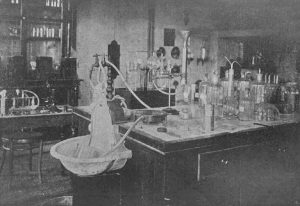
After a major cholera epidemic in Istanbul in 1893, the Ottoman state asked the Pasteur Institute in France for help, and the institute sent the bacteriologist André Chantemesse to assess the situation. In his report, Chantemesse advised the Ottoman government to set up a bacteriology laboratory. As a result, our first modern biotechnology centre, the Bakteriyolojihane-i Osmani research centre, was founded in Istanbul in 1894. The young French researcher Dr. Maurice Nicolle worked there alongside Turkish scientists whom the Ottoman state had sent to France for training, and they carried out internationally important work on topics such as diphtheria serum and rinderpest. In the same years, smallpox vaccine production began at the Telkihhane-i Şahane, which continues today as the Pendik Veterinary Control Institute.
The long period of war that lasted until the founding of the Republic stalled medical biotechnology, as it did every other field. After the Republic was founded, the Hıfzıssıhha Institute under the Ministry of Health and the medicine, engineering and science faculties of universities achieved important results at various times. However, limited funding, and the fact that the work relied on individual effort and sacrifice, kept us from catching up with the leading countries of the era, as in other fields.

A Ministry of Development report describes the current situation as follows: “Türkiye has fallen well behind in biotechnology because of shortages of trained staff, laboratory infrastructure and research facilities.” After molecular biology and genetics undergraduate programmes were set up at universities in 1995, the shortage of skilled people began to ease. But because universities were not in contact with the sector, the training stayed theoretical and could not meet the sector’s workforce needs. Over the last 10 years, a programme first launched by the Ministry of Industry as SAN-TEZ and later transferred to TÜBİTAK, aimed at meeting industry’s need for qualified staff, has made major progress. Together with support for young entrepreneurs, it has revitalised the market. Although TÜBİTAK’s industry funding has fallen in dollar terms for economic reasons, funding for biotechnology continues to grow, if only slightly.

TÜBİTAK TEYDEB funding by year

TEYDEB funding by sector
Public-interest calls, such as those for biosimilar drugs and vaccines, and large grants from the Ministry of Development and TÜBİTAK in these areas have also made important contributions. However, because problems with taxation and customs persist, the materials used in this work are still sold at very high prices in Türkiye. Intermediaries that simply buy and resell profit easily, while manufacturers and researchers struggle to continue their work.
The progress made in medical biotechnology in Türkiye over the last 20 years has laid the groundwork for the next stage. Together with academics and industry, our association has prepared a biotechnology roadmap that sets out the leap needed to reach that stage. To view the roadmap: BIOTECHNOLOGY ROADMAP